Chimney leaks
Chimney flashing and cricket repair in Long Beach, CA
Water comes in around your chimney every time it rains hard, and patching the mortar or caulking the flashing has not solved it.
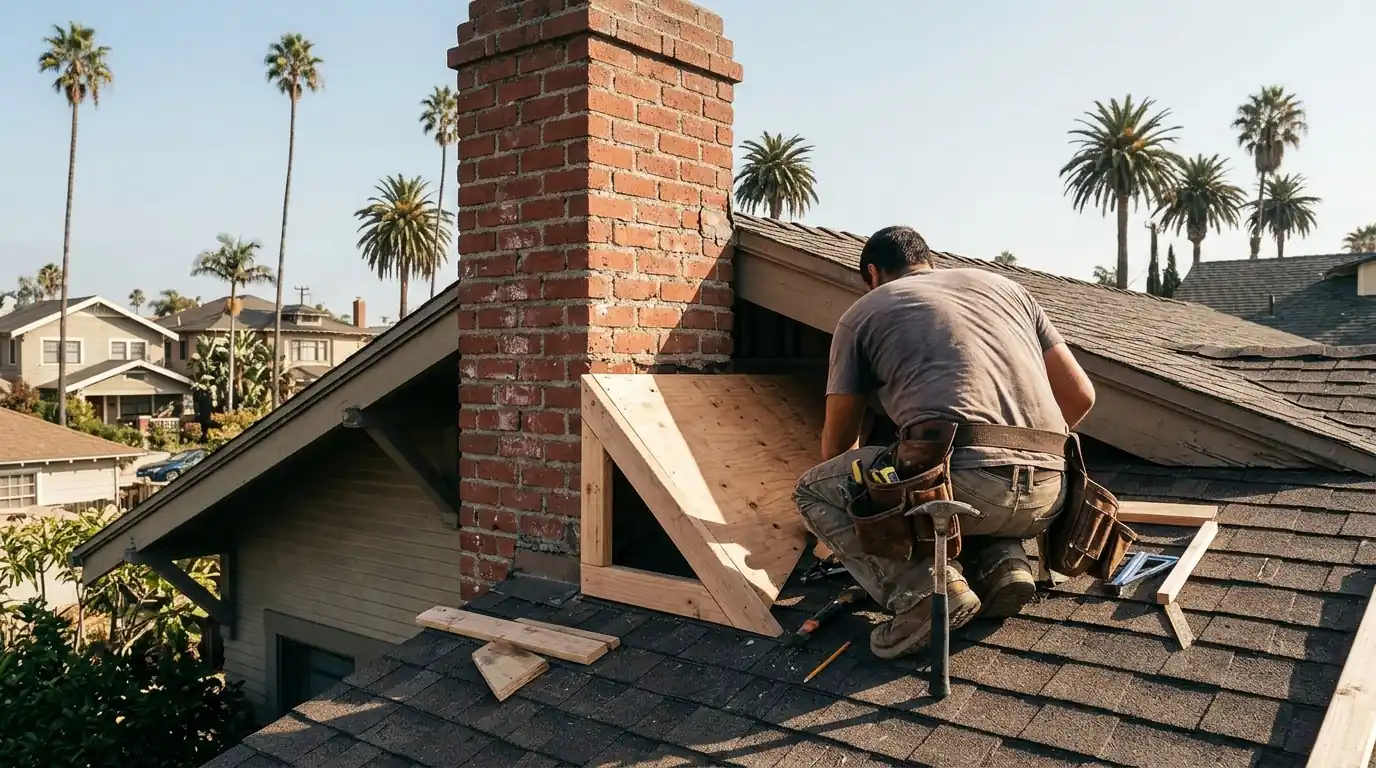
Chimney flashing seals the gap between the chimney and the roof, and a cricket is a small peaked structure behind the chimney that splits water around it. Most chimney leaks come from failed flashing or a missing cricket. Expect $640 to $2,180, priced after our roofer inspects the chimney.
A chimney is a big box sticking up through the roof, and water hits the uphill side of it with nowhere to go. On a wide chimney, water and debris pile up behind it during every rain. If there is no cricket to divert that water, and the flashing around the base is old, rusted or loose, the chimney leaks.
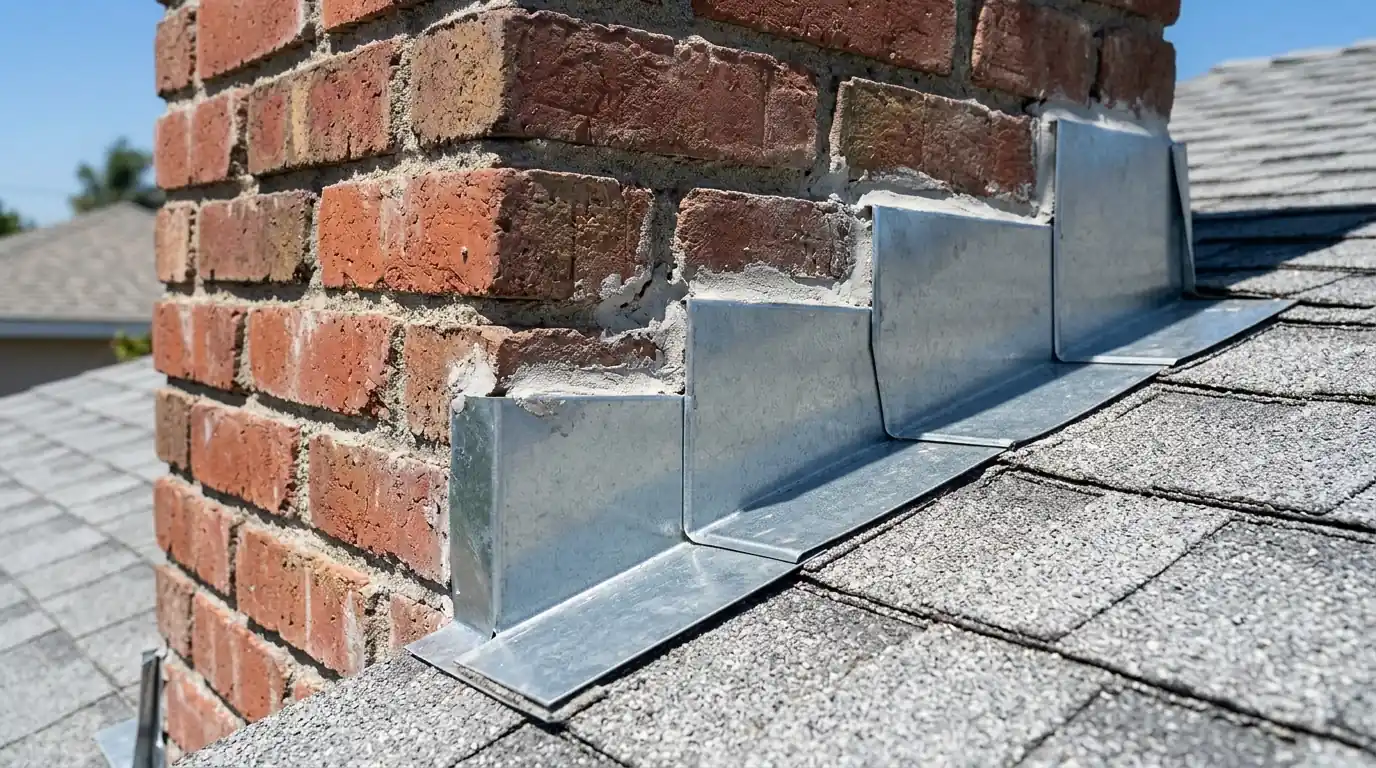
Our roofers rebuild chimney flashing the full way: step flashing up the sides, a counter flashing cut into the mortar joints or stucco, an apron at the front, and a properly flashed cricket at the back when the chimney is wide enough to need one. We also check the chimney itself for cracks and loose brick that can let water in from above the roofline.
What a cricket does and when you need one
A cricket, sometimes called a saddle, is a small ridged roof built on the uphill side of the chimney. It turns the flat dam behind the chimney into two little slopes, so water and debris flow around the chimney instead of sitting against it. Wider chimneys are the ones that need it, and many older homes were built without one.
We frame the cricket from lumber, sheath it, cover it with underlayment, and flash it with metal or cover it with roofing that matches the rest of the roof. Done right, it ends the pooling that causes most rear chimney leaks.
- Diverts water around wide chimneys
- Stops leaves and debris piling up behind
- Framed, sheathed and fully flashed
- Covered in metal or matching roofing
How chimney flashing is built
Chimney flashing is a two-part system. The base flashing, steps along the sides and an apron at the front, is tied into the roofing. The counter flashing is set into the chimney itself, cut into a mortar joint on brick or into the stucco, and laps down over the base flashing. That overlap lets the roof and chimney move separately without opening a gap.
Many chimney leaks we see have only a single layer of metal, glued or caulked to the face of the brick. When the caulk lets go, water runs right behind it. Rebuilding with proper counter flashing stops that.
Brick, stucco and seismic concerns
Older Long Beach homes have brick chimneys, and some newer ones have wood-framed chimney chases with stucco. Brick can absorb water through cracked mortar and crowns, which looks like a flashing leak but starts higher up. Stucco chases crack and leak at the top. We check the crown, mortar and cap as part of every chimney flashing job.
Unbraced brick chimneys are a known risk in earthquakes. We do not do masonry rebuilds, but if we see loose brick, wide cracks or a chimney that has shifted, we tell you so you can have it looked at by a chimney or masonry specialist.
- Cracked crowns and mortar on brick chimneys
- Stucco cracks and failed caps on framed chases
- Loose brick or a chimney that has shifted
- Rusted chimney caps and spark arrestors
When to call about chimney flashing & crickets
Stains beside the fireplace
Water marks on the ceiling or wall next to the chimney or the fireplace mantel.
Water behind the chimney
Debris and standing water on the roof behind a wide chimney after rain.
Caulk-only flashing
Flashing held on with sealant against the brick, with no counter flashing cut into the joints.
Rusted or loose metal
Chimney flashing that is rusted, bent or pulled away from the brick or stucco.
Damp attic near chimney
Wet framing, stained sheathing or a musty smell around the chimney in the attic.
Cracked crown or mortar
Visible cracks in the concrete crown on top or gaps in the mortar joints.
Typical cost in Long Beach
What chimney flashing & crickets usually costs
$640 to $2,180
- Width of the chimney and whether it needs a cricket
- Brick versus stucco chimney
- Tile versus shingle roofing around it
- Rot found in the decking around the base
- Height and pitch of the roof
This is a typical Long Beach range, and your price comes after our roofer has seen the chimney. See every price range.
Chimneys on older Long Beach homes
Many of the city's chimneys sit on the Craftsman bungalows and Spanish Revival homes built in the 1910s through the 1930s in Belmont Heights, Bluff Heights, California Heights and Bixby Knolls. A lot of those chimneys are wide brick, original to the house, and were built without a cricket. Their flashing has often been patched many times with caulk over the decades.
Some homeowners in these neighborhoods no longer use the fireplace, but the chimney still has to keep water out. In historic districts we keep the chimney's look the same, matching flashing lines and roofing around it. Post-war ranch homes in Los Altos and Lakewood Village have their own chimney styles, often brick or block, and the same flashing principles apply.
How the job runs
How our crew handles chimney flashing & crickets
- 1
Inspect chimney and roof
Our roofer checks the flashing, the crown, mortar, cap and the attic around the chimney.
- 2
Remove old flashing
We pull the old metal and caulk, and the roofing around the chimney base.
- 3
Build the cricket
On wide chimneys, we frame and sheath a cricket on the uphill side to divert water.
- 4
Install new flashing
Step, apron and cricket flashing go in, then counter flashing set into the brick or stucco.
- 5
Restore and test
We put the roofing back, seal the counter flashing, and water-test around the chimney.
FAQ
Chimney Flashing & Crickets questions
Does my Long Beach chimney need a cricket?
Wider chimneys need one because water and debris pile up behind them. Many older Long Beach homes were built without one. Our roofer will measure the chimney and tell you if adding a cricket will solve your leak.
What does chimney flashing and cricket repair cost in Long Beach?
Our typical range is $640 to $2,180. Reflashing a small chimney costs less, while a wide chimney that needs a new cricket and roofing work around it is at the higher end. We price it after inspecting.
Can a chimney leak come from the brick and not the flashing?
Yes. Cracked crowns, worn mortar and missing caps let water soak into the chimney above the roof. We check those during every chimney job and tell you if the source is the masonry.
Why does my chimney still leak after the flashing was caulked?
Caulk alone cracks in our sun and lets go from the brick. Proper chimney flashing has counter flashing set into the mortar joints, lapping over base flashing. We rebuild it that way.
Can you fix the chimney flashing if my Long Beach fireplace is not used anymore?
Yes. The chimney still sits in the roof and still needs to keep water out. Whether to keep or remove an unused chimney is a separate question for a masonry or chimney specialist.
Where we do this work
Chimney Flashing & Crickets around Long Beach
Our crews do this work across Long Beach and the cities around it. A few of the places we cover:
A leak, a quote, or a question about your roof?
Call Denco at (562) 414-1770. Someone answers 24 hours a day, and our crews work out of Long Beach and La Mirada.