Lift and relay
Tile underlayment replacement in Long Beach, CA
Your tile looks fine from the street, but water keeps getting into the ceiling. Under the tile, the old felt has likely dried out and cracked.
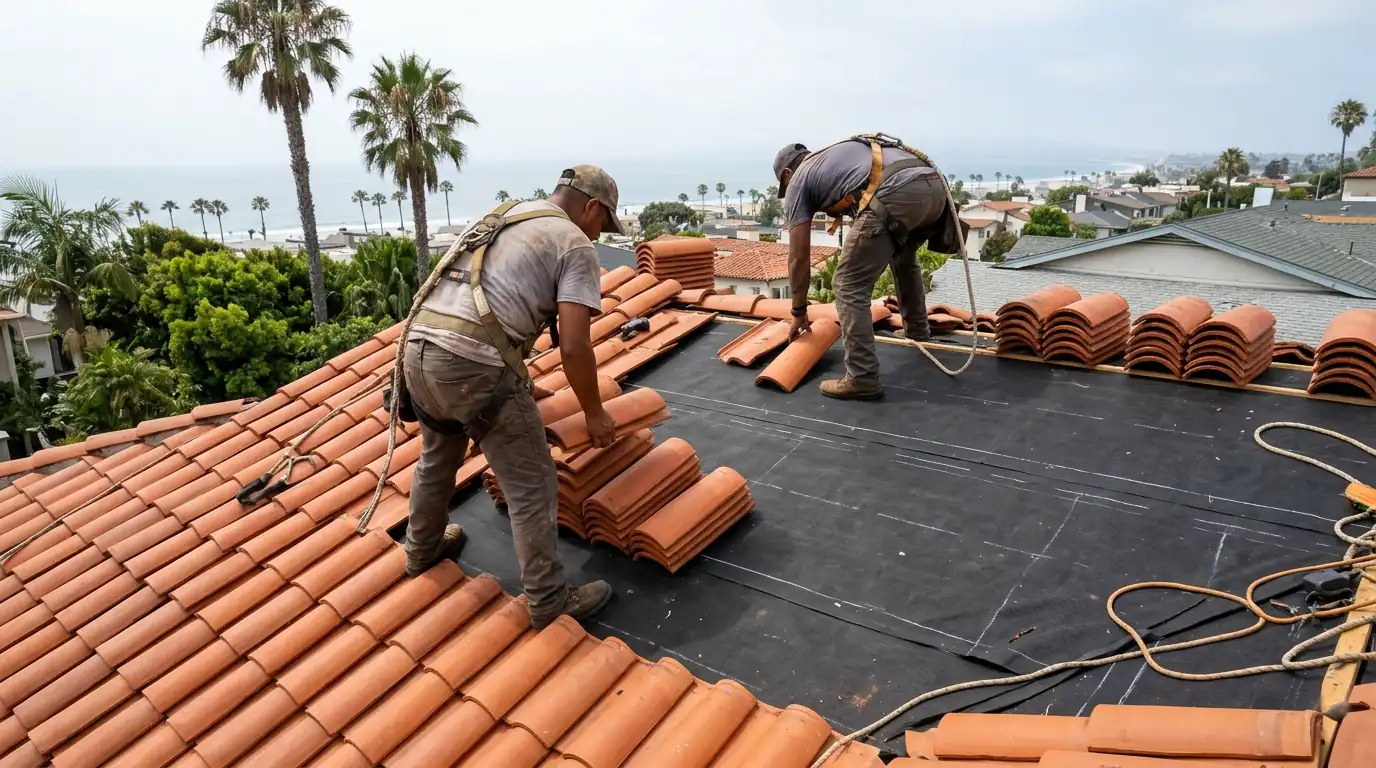
Tile underlayment replacement, often called lift and relay, means removing your tiles, replacing the worn underlayment and flashings, and putting the sound tiles back. It is the fix when the tile is still good but the layer beneath it has failed. In Long Beach it typically costs $9.40 to $15.80 per sq ft.
Clay and concrete tile can last for many decades. The felt paper under it does not. After 20 to 30 years of summer heat in the attic and sun through gaps in the tile, that felt turns brittle, tears at the nail holes and lets water through. The tile is only the first shield. The underlayment is what keeps your house dry.
A lift and relay keeps the tile you already own and replaces what is failing. It costs less than a new tile roof, keeps the original look of the house and removes the source of most tile roof leaks.
Why the tile outlasts the felt under it
Tile sheds most of the rain, but wind-driven water still slips under the laps, especially during the winter atmospheric-river storms. That water runs down the underlayment to the eave. When the felt is sound, it never reaches the wood. When it is cracked, it soaks the decking and finds a ceiling.
Valleys and the lower courses near the eaves wear out first, because they carry the most water. Old flashings at walls and chimneys rust, and mortar at the ridge cracks. A lift and relay replaces all of those weak points at once.
What happens on the roof during a lift and relay
We remove the tiles by hand and stack them on the roof or in the yard, sorted by row and type. Cracked pieces are set aside. Then we strip the old felt and battens down to the decking, replace any rotted boards and sweep the deck clean.
New underlayment goes down in two layers or as a heavy synthetic, followed by new valley metal, wall flashing, pipe jacks, eave closures and battens where the system calls for them. Then the good tiles go back in their original pattern, fastened to current practice.
- Tiles removed and stacked by hand
- Old felt, battens and nails stripped
- Rotted decking replaced
- New underlayment, valley metal and flashings
- Sound tiles reinstalled and fastened
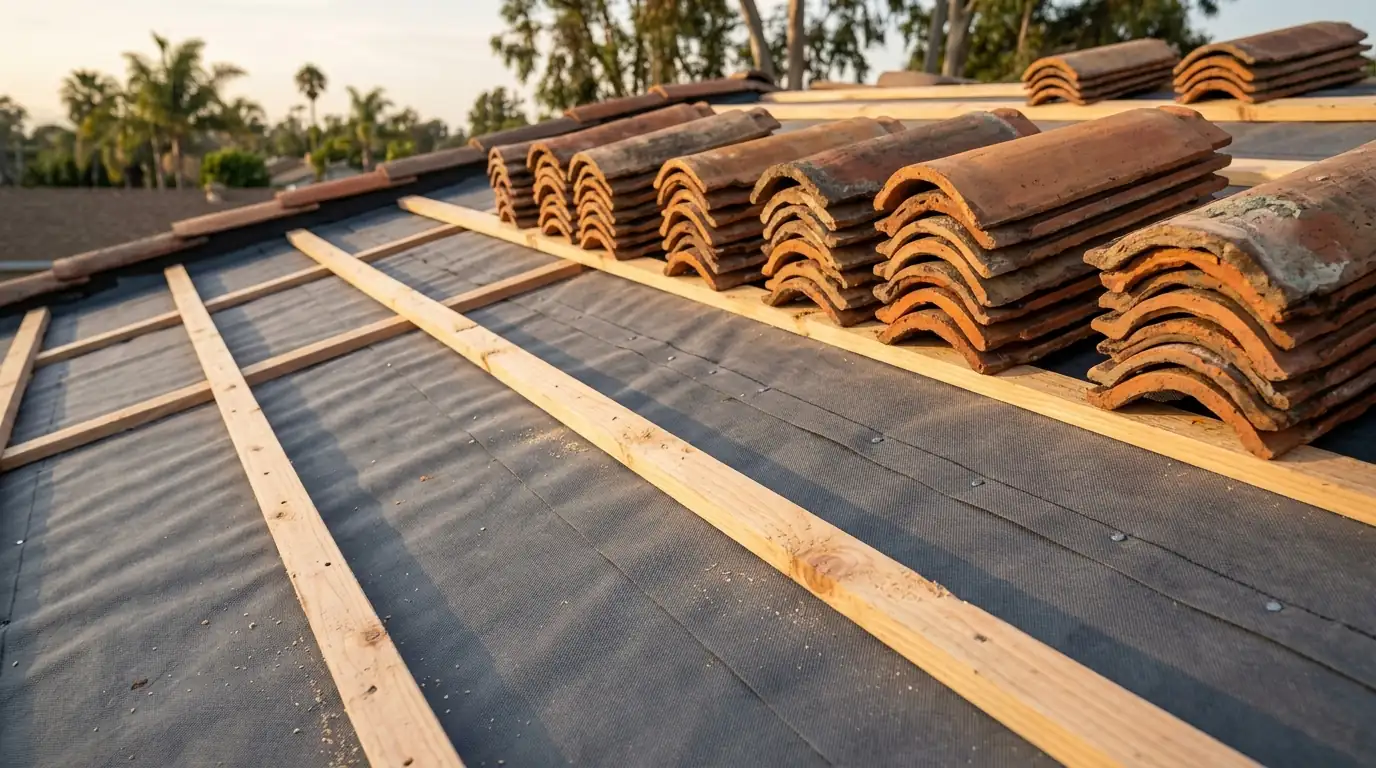
Matching broken and discontinued tile
Most roofs lose some tiles during removal, plus the ones that were already cracked. We match replacements by profile, size and color. For common concrete S-tile, current production often fits. For older clay barrel tile or discontinued profiles, we source salvage tile from reclaimed stock.
If a perfect match is hard to find, we move original tiles to the most visible slopes and place the replacements on the back or less visible sides. That keeps the street view of your home consistent.
Lift and relay versus spot repair
A spot repair, where we lift a few rows and patch the felt under them, can buy time on a roof that has one problem area. It is the right call when the rest of the underlayment is still flexible. When the felt is brittle everywhere, a patch only moves the leak a few feet over.
We show you photos from several lift points so you can see the condition of the underlayment yourself and decide between a repair now or a full relay.
When to call about tile underlayment replacement
Leaks with no broken tile
Water in the ceiling while every tile looks whole usually points to failed felt.
Original felt aging out
That is the age range where original tile underlayment often gives out.
Stains near exterior walls
Water reaching the eave decking tends to show up at ceiling edges along outside walls.
Brittle felt at the eave
If the paper crumbles when we lift a tile, the rest of the roof is usually the same.
Rusty valley metal
Corroded valleys under tile leak in heavy rain and need replacing with the underlayment.
Solar planned on tile
Relaying the tile first means you will not pay to remove panels later to fix leaks.
Typical cost in Long Beach
What tile underlayment replacement usually costs
$9.40 to $15.80 per sq ft
- Clay versus concrete tile and how fragile it is
- Number of replacement tiles needed and how rare the profile is
- Amount of decking repair
- Roof pitch and number of valleys and hips
- Chimneys, skylights and solar mounts to flash
We give you a firm number after we lift tiles and see what is underneath. See every price range.
Tile roofs in Long Beach that are due for new underlayment
Long Beach has two big groups of tile roofs. Spanish Revival homes from the 1920s and 1930s in Bluff Park, Belmont Heights and Los Cerritos carry clay barrel tile, often on their second or third underlayment. Newer homes and many 1980s and 1990s re-roofs in East Long Beach used concrete S-tile, and those original felts are now reaching the end of their life.
A lift and relay is a re-roof under city rules, so it needs a Long Beach building permit. In historic districts, keeping the original tile is often the easiest way to satisfy design review. Near the ocean we use corrosion-resistant fasteners and flashings, since salt air shortens the life of plain steel.
How the job runs
How our crew handles tile underlayment replacement
- 1
Lift test tiles
We lift tiles in several spots to check the underlayment, decking and tile condition.
- 2
Count and source tile
We estimate breakage and line up matching replacement tile before work starts.
- 3
Remove and stack
Our crew takes tiles off by hand, sorts them and strips the old underlayment.
- 4
Rebuild the waterproofing
New underlayment, valley metal, flashings and battens go down over repaired decking.
- 5
Relay the tile
Good tiles go back in place, matched tiles fill gaps, and ridge and hips are reset.
FAQ
Tile Underlayment Replacement questions
How many tiles break during a tile underlayment replacement?
It depends on the tile age and type. Concrete tile usually holds up well, while old clay can be more fragile. We estimate breakage before starting and source matching tile so the job is not held up.
Is a lift and relay cheaper than a new tile roof?
Usually, yes, because you keep the tile, which is the most expensive part of the roof. You still get all new underlayment and flashings. If many tiles are badly worn, we may recommend new tile instead.
What underlayment do you use when relaying a tile roof?
We use either two layers of heavy felt or a high-temperature synthetic made for tile, depending on the roof. Valleys get new metal and the eaves get new closures. We explain the system before we start.
Can you relay tile on just one slope of the roof?
Yes, if the damage is limited to one area and the rest of the underlayment checks out. We tie the new underlayment into the old carefully. If the rest of the roof is the same age, a full relay often makes more sense.
Will my Spanish tile roof look different after the lift and relay?
It should look the same, since we reuse your original tile. Any matched replacements go on the less visible slopes when possible. Ridge and hip tiles are reset in their original style.
Where we do this work
Tile Underlayment Replacement around Long Beach
Our crews do this work across Long Beach and the cities around it. A few of the places we cover:
A leak, a quote, or a question about your roof?
Call Denco at (562) 414-1770. Someone answers 24 hours a day, and our crews work out of Long Beach and La Mirada.