Roof edge dry rot
Fascia and eave repair in Long Beach, CA
The wood along your roof edge is soft, cracked or peeling, and the gutters are pulling loose or the eaves are sagging.
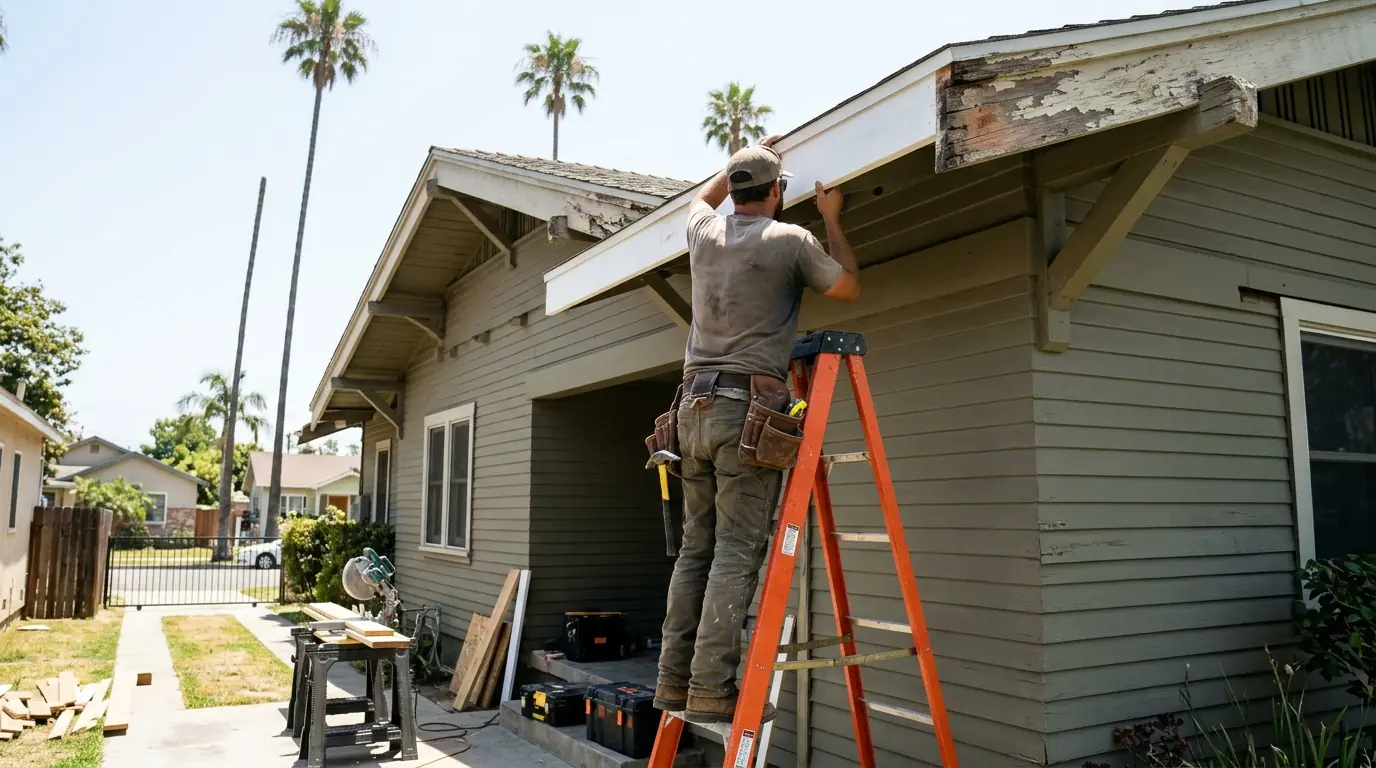
Fascia and eave repair replaces rotted fascia boards, rafter tails, eave sheathing and soffits at the edge of the roof. Dry rot and water damage are common on older Long Beach homes. Expect $18.50 to $36.40 per linear foot, confirmed after we see how far the rot goes.
The roof edge takes a beating. Water runs off the roof onto it, gutters overflow onto it and the sun bakes it. On older wood homes in Long Beach, the fascia boards and exposed rafter tails are often the first part of the roof structure to rot. Once they go soft, gutters pull away, paint peels and eaves start to sag.
Our crews cut out the rotted wood, replace it with new lumber sized and shaped to match, and install drip edge so water clears the fascia going forward. On exposed-rafter Craftsman and ranch homes, we can splice or replace rafter tails to match the original profile so the eave line looks the way it should.
Fascia, soffit, rafter tails and eave sheathing
Fascia is the board along the ends of the rafters where gutters attach. Soffit is the underside of a boxed eave. On open eaves, common on Craftsman and mid-century homes, there is no soffit: the rafter tails are exposed and the underside of the roof sheathing, called eave sheathing or skip sheathing, is visible from below.
Each of these can rot. We open the area, probe the wood and replace what is soft, from a short piece of fascia to a full run of rafter tails and eave boards. On boxed eaves we also check the soffit vents, because blocked or missing vents trap hot, damp air in the attic and add to the decay. Where vents are painted shut or crushed, we replace them while the eave is open.
- Fascia boards behind the gutters
- Boxed soffits on enclosed eaves
- Exposed rafter tails on open eaves
- Eave sheathing visible from below
Why the roof edge rots
Most fascia rot starts with missing drip edge. Without it, water runs off the roof and wicks into the top of the fascia board. Overflowing or clogged gutters soak the wood every rain. Paint fails in the sun, leaving bare wood that cracks and takes on water.
Termites and dry rot fungus also attack eave wood on older homes. If we find termite damage, we tell you so you can have it treated before we install new wood.
- No drip edge at the roof edge
- Overflowing or clogged gutters
- Peeling paint and bare wood
- Termite or fungal damage in older lumber
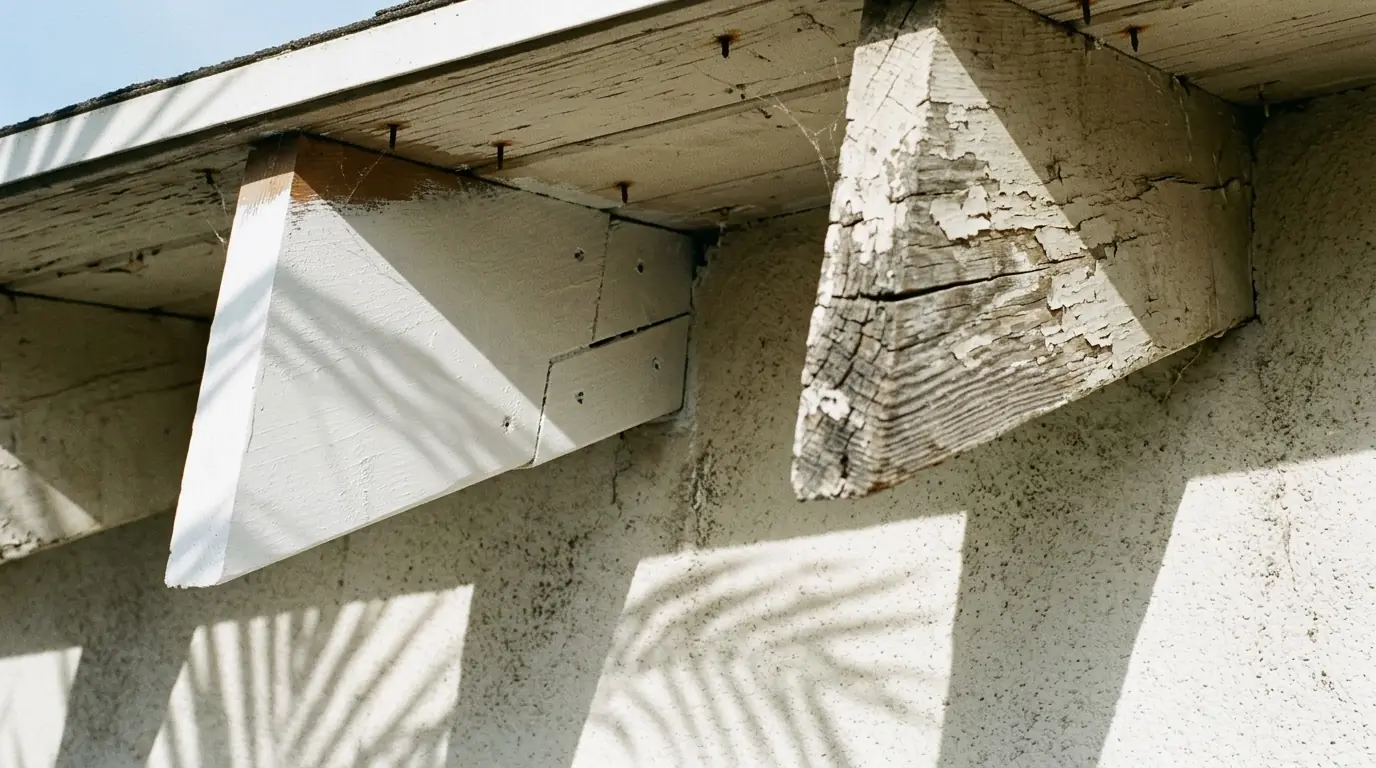
How we repair the edge so it lasts
We remove the gutters if needed, cut out rotted fascia and rafter tails back to sound wood, and install new lumber primed on all sides. Rafter tails get spliced and fastened to the existing rafters, and we match the cut profile of the originals. Eave sheathing is replaced to match its width and look from below.
Then we install drip edge so water drips clear, rehang the gutters on sound wood, and prime the new wood ready for paint. If the roofing at the edge is worn or cracked, we repair those first few courses at the same time so the new wood is protected from day one. We can match the existing trim profile closely so it blends once painted.
When to call about fascia & eave repair
Soft or crumbling fascia
Wood along the roof edge that gives under a screwdriver or breaks apart.
Gutters pulling away
Gutters sagging or separating from the house because their fasteners have no solid wood to hold.
Peeling paint at the eaves
Paint that keeps peeling on fascia and rafter tails even after repainting.
Sagging eaves
A roof edge that dips or droops instead of running straight.
Stains under the eaves
Dark water marks on soffits or the underside of eave boards.
Pests at the roof edge
Birds, bees or rodents getting in through gaps in rotted fascia or soffit.
Typical cost in Long Beach
What fascia & eave repair usually costs
$18.50 to $36.40 per linear foot
- How deep the rot goes, fascia only or into rafter tails
- Open eaves with exposed rafters versus boxed soffits
- Matching custom trim or rafter profiles
- Gutter removal and reinstallation
- Height and access along the eave
We measure the run and confirm the price after probing the wood, since rot often goes further than it looks. See every price range.
Dry rot on Long Beach eaves
Long Beach has a lot of exposed eaves. Craftsman bungalows in Belmont Heights, Bluff Heights and California Heights have open rafter tails, often original wood from the 1910s and 1920s. The 1950s ranch homes in Los Altos, the Plaza and Lakewood Village have long, low eaves, and the Cliff May homes in Rancho Estates have wide overhangs. All of that wood takes years of sun and occasional soaking rains.
Our sun cracks paint quickly, and once the wood is bare, the winter rains get in. Near the coast in Belmont Shore and Naples, salt air and marine layer keep wood damp longer. Matching original rafter tail profiles matters on homes in historic districts, so we cut new tails to match the originals.
How the job runs
How our crew handles fascia & eave repair
- 1
Probe and measure
Our crew checks the full run of fascia, rafter tails and eaves for rot and measures what needs replacing.
- 2
Remove gutters and rot
We take down gutters where needed and cut out rotted wood back to solid framing.
- 3
Install new wood
New fascia, rafter tails and eave boards go in, primed and shaped to match the originals.
- 4
Add drip edge
We install drip edge so water clears the fascia, then rehang the gutters.
- 5
Ready for paint
The new wood is primed and ready for paint, and we send photos of the finished edge.
FAQ
Fascia & Eave Repair questions
What does fascia and eave repair cost in Long Beach?
Our typical range is $18.50 to $36.40 per linear foot. Fascia-only replacement is at the lower end, while runs that include rafter tails and eave boards cost more. We measure and confirm after probing the wood.
Can you match the exposed rafter tails on my Long Beach Craftsman?
Yes. We cut new rafter tails to match the profile of the originals and splice them onto sound rafters. Once painted, they blend with the rest of the eave line.
Why does my fascia keep rotting even after it was replaced?
Usually because there is no drip edge, so water runs behind the gutter and into the fascia. Overflowing gutters do the same. We add drip edge and make sure gutters are hung correctly.
Do I need to paint new fascia right after it is installed?
Yes, as soon as you can. We prime the new wood, but primer alone does not hold up long in our sun. Paint protects the wood and keeps the repair lasting.
What if you find termites in my eaves during fascia repair?
We stop and show you the damage. Termites should be treated by a pest control company before new wood goes in, otherwise they move into it.
Where we do this work
Fascia & Eave Repair around Long Beach
Our crews do this work across Long Beach and the cities around it. A few of the places we cover:
A leak, a quote, or a question about your roof?
Call Denco at (562) 414-1770. Someone answers 24 hours a day, and our crews work out of Long Beach and La Mirada.