Walls, valleys and vents
Roof flashing repair in Long Beach, CA
Your roof leaks where it meets a wall, a valley or a vent, and the metal there is rusted, bent or buried under old caulk.
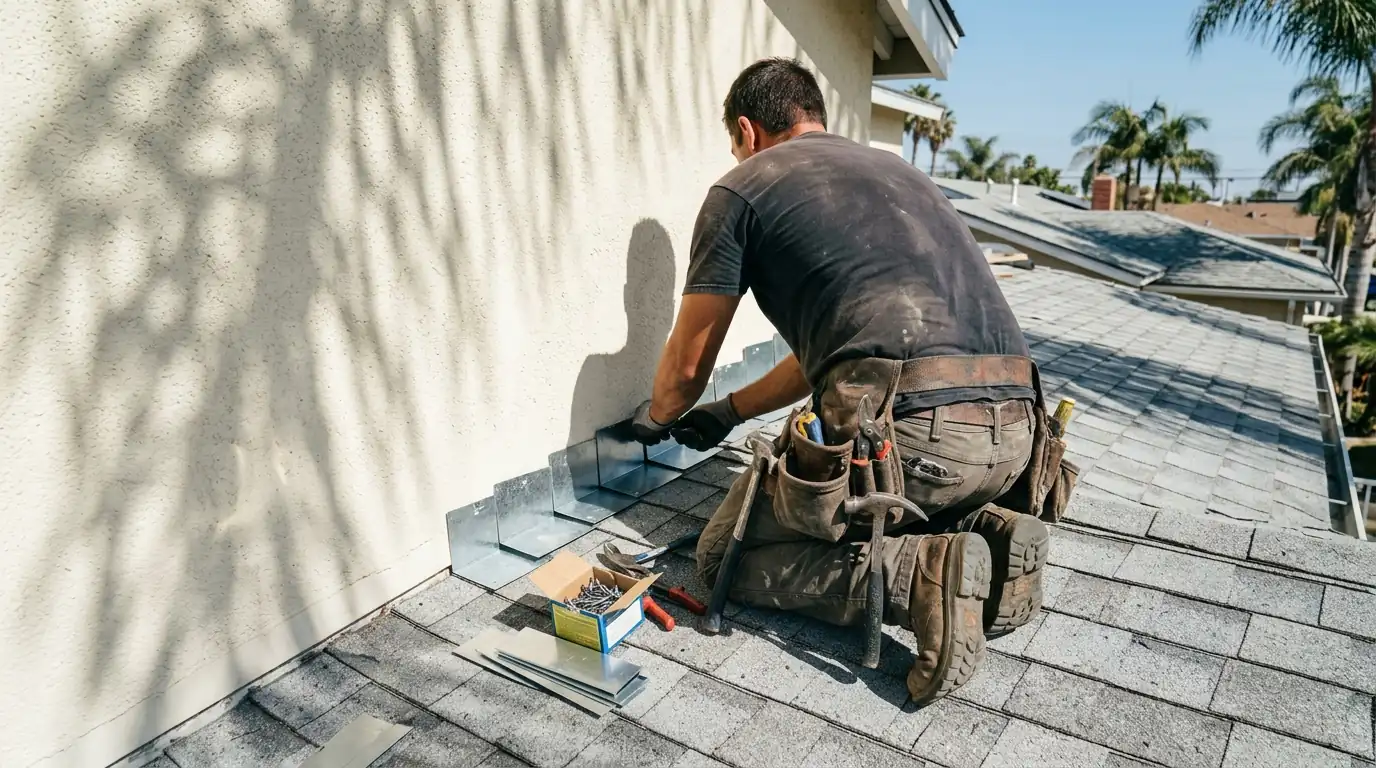
Flashing is the metal that seals the joints of a roof: where it meets walls, in valleys, around vents and along the edges. Flashing repair replaces failed pieces so water runs over the joint instead of into it. Expect $310 to $1,090 per flashing area, confirmed after we inspect.
The open field of a roof rarely leaks. The joints do. Anywhere the roof changes direction or something passes through it, a piece of metal flashing has to carry water past the gap. When that metal rusts, bends, pulls loose or was installed backward, water goes behind it and into the house.
We see a lot of flashing that has been caulked over and over instead of replaced. The caulk cracks in the sun, traps water and hides the rust underneath. Our roofers remove the old metal, install new flashing lapped the right way, and tie it back into the roofing and the wall so it sheds water without depending on sealant.
The types of flashing on a roof
Step flashing runs in short overlapping pieces where a sloped roof meets a side wall, one piece under each course of shingle or tile. Counter flashing covers the top of step flashing and is tucked into the wall or stucco. Headwall flashing runs along the top where a roof meets a wall above it. Valley flashing lines the trough where two slopes meet.
Drip edge runs along eaves and rakes so water drips clear of the fascia. Vent and pipe flashings seal around anything that comes through the roof. Each has a job, and each fails in its own way.
- Step and counter flashing at side walls
- Headwall flashing at the top of a slope
- Valley metal where two slopes meet
- Drip edge at eaves and rakes
- Vent, pipe and appliance flashings
How flashing fails
Rust is the most common failure near the coast, where salt air eats through galvanized steel. Older homes often have flashing that was never replaced during later re-roofs, so the metal is decades old under newer shingles or tile. Stucco and siding work can bury or cut flashing, and patio covers and additions often get tied in without proper flashing at all.
We also find flashing that was installed upside down, lapped so water runs behind the metal instead of over it. No amount of sealant fixes that. The only real repair is to take it out and put it back the right way.
- Rusted metal near the ocean
- Old flashing left behind during a re-roof
- Flashing cut or buried by stucco work
- Reverse laps that send water behind the metal
- Additions tied in with caulk only
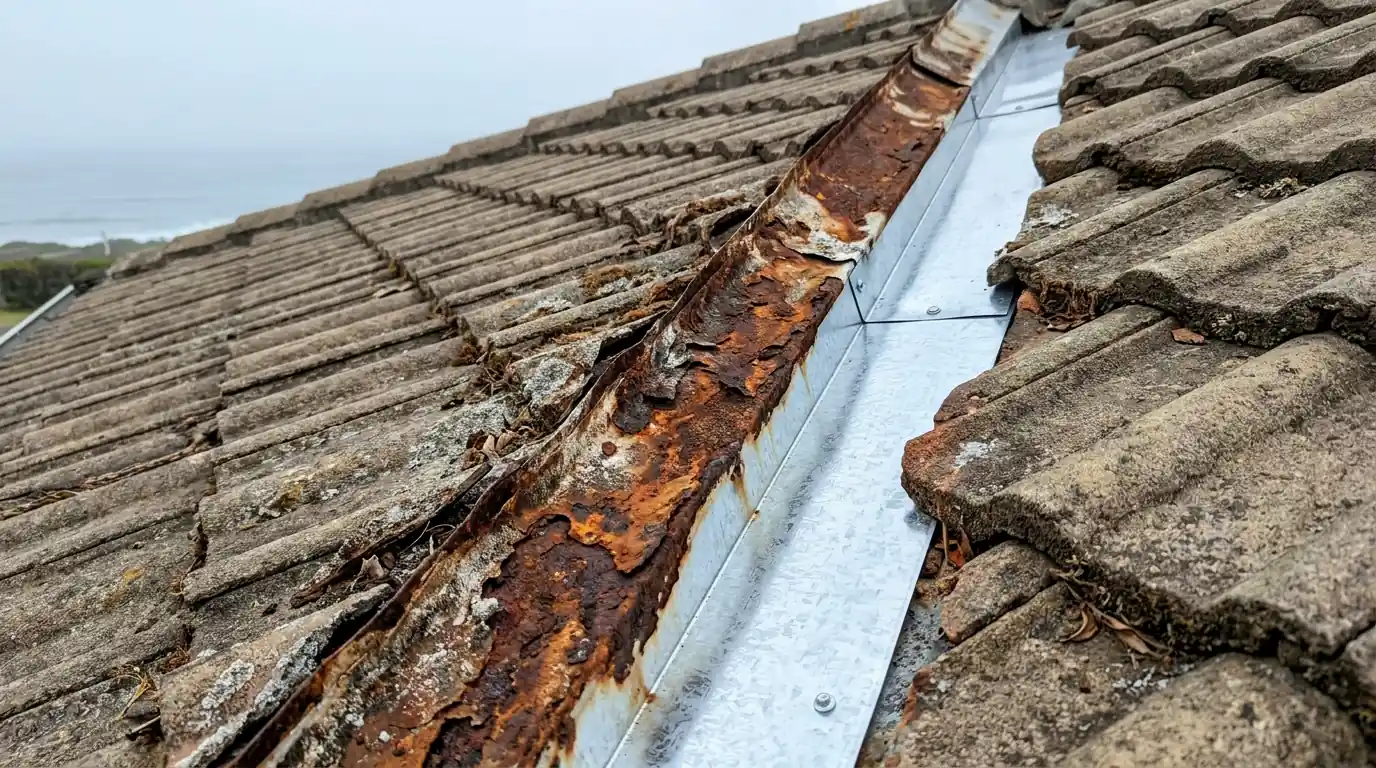
How we replace flashing
We remove the shingles or tiles around the joint, pull the old flashing, and check the decking and wall sheathing behind it for rot. New underlayment goes up the wall, then new flashing, lapped so every piece sheds water onto the piece below it. On stucco walls, we cut a clean reglet or use surface-mounted counter flashing so the top edge stays sealed.
Near the ocean, we use metals and fasteners that hold up better in salt air. Then the roofing goes back on over the new flashing, so the system works the way it was meant to.
When to call about roof flashing repair
Leak along a wall
Stains on a ceiling or wall right where an upper wall or addition meets the roof.
Rust streaks
Orange or brown streaks running down from flashing, vents or the roof edge.
Thick layers of caulk
Built-up sealant along a wall or valley, a sign the metal beneath has been failing for a while.
Lifted or bent metal
Flashing pulled away from a wall or bent up by wind, leaving a visible gap.
Stucco cracks at the roofline
Cracked or stained stucco where the roof meets a wall, often from water behind the flashing.
Vent or pipe leak
Water around a plumbing vent, exhaust fan or furnace flue that comes through the roof.
Typical cost in Long Beach
What roof flashing repair usually costs
$310 to $1,090 per flashing area
- Type of flashing and length of the joint
- Tile versus shingle roofing around it
- Stucco cutting or patching at the wall
- Rot found behind the old metal
- Metal type chosen for coastal homes
Each flashing area is priced after our roofer has seen it, and you approve before work starts. See every price range.
Salt air, stucco and flashing in Long Beach
Homes within a mile or two of the ocean, in Belmont Shore, Naples, Alamitos Beach and along the bluff, lose flashing to corrosion far faster than inland homes. We often find flashing on these homes rusted through underneath while the roofing over it still looks fine. Replacing it with better-suited metal and fasteners makes a real difference here.
Long Beach is also a stucco city. Spanish Revival homes from the 1920s and 1930s, and plenty of ranch homes since, have stucco walls meeting the roof, and every repaint or stucco patch is a chance for flashing to get buried or cut. On older homes in historic districts like Bluff Park and Rose Park, we keep the visible lines of the wall and roof the same when we replace flashing.
How the job runs
How our crew handles roof flashing repair
- 1
Find the failed joint
Our roofer traces the leak and inspects every flashing near it, inside and out.
- 2
Open the roof around it
We carefully remove shingles or tiles to reach the old flashing without damaging the rest.
- 3
Check what is behind
We inspect decking and wall sheathing behind the old metal and replace any rot.
- 4
Install new flashing
New underlayment and new metal go in, lapped so water always flows over, never behind.
- 5
Close and seal
We reinstall the roofing, finish the counter flashing at the wall and send photos of the work.
FAQ
Roof Flashing Repair questions
Why does roof flashing rust so quickly on my Long Beach home near the beach?
Salt in the marine air settles on metal and speeds up corrosion, especially on galvanized steel and plain fasteners. Homes within a mile or two of the water see it most. We use metals and fasteners better suited to that exposure when we replace it.
Can roof flashing repair be done without replacing the whole roof?
Yes. We remove only the roofing around the joint, replace the flashing and the underlayment there, and put the roofing back. Most flashing repairs are a day or less.
What does roof flashing repair cost in Long Beach?
Our typical range is $310 to $1,090 per flashing area. A single pipe flashing is at the low end, while a long wall run with stucco work is higher. We price each area after inspecting it.
Is caulking over old flashing a good enough fix?
It might stop a drip for a season, but caulk cracks in our sun and can trap water behind it. If the metal is rusted or installed wrong, it needs replacing. We remove the old caulk and metal rather than adding more layers.
Why does my Long Beach patio cover or addition leak where it meets the house?
Many additions and patio covers were tied into the house with sealant and no real flashing. Water runs down the wall and behind the joint. We install proper flashing at that connection so water sheds onto the new roof instead.
Where we do this work
Roof Flashing Repair around Long Beach
Our crews do this work across Long Beach and the cities around it. A few of the places we cover:
A leak, a quote, or a question about your roof?
Call Denco at (562) 414-1770. Someone answers 24 hours a day, and our crews work out of Long Beach and La Mirada.