White single-ply membrane
TPO roofing in Long Beach, CA
Your low-slope roof bakes in the sun all summer, the rooms under it run hot, and the old black surface is cracking at every seam.
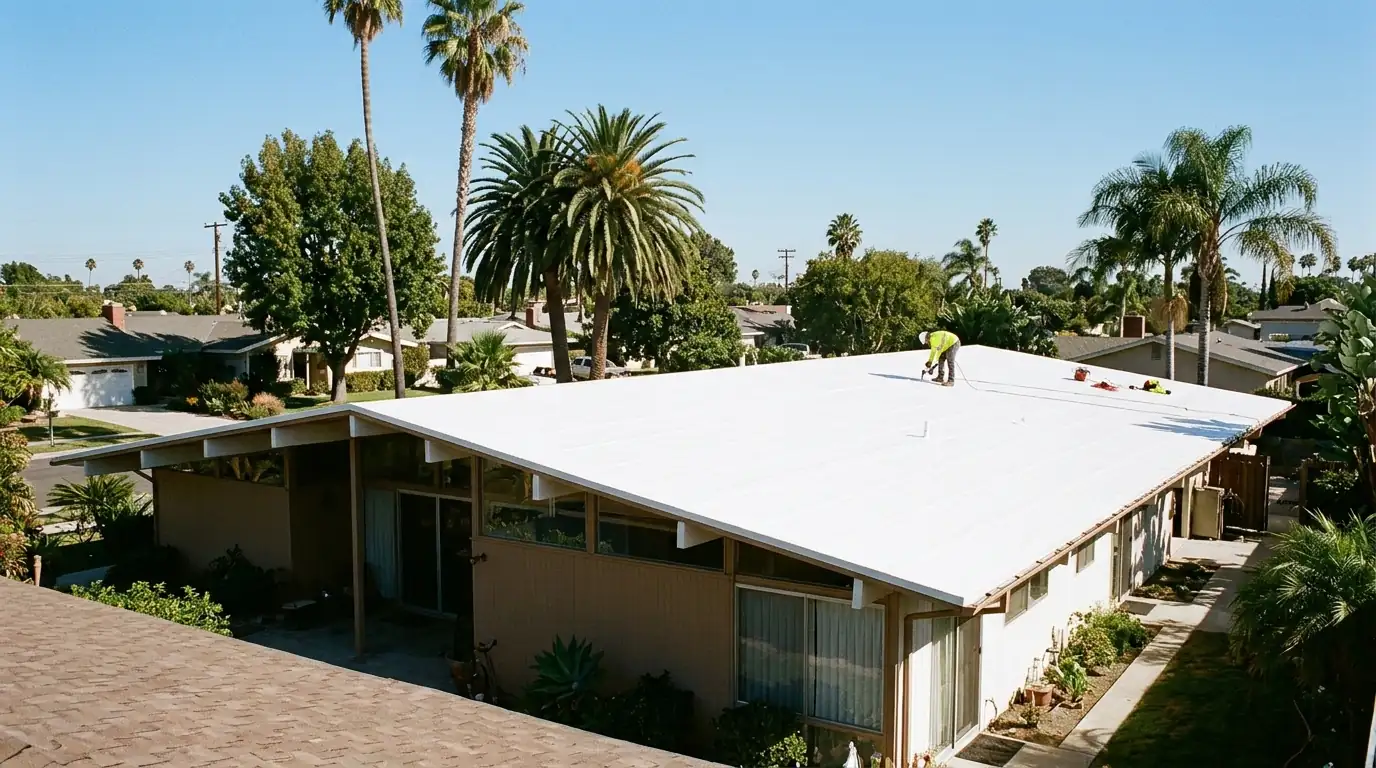
TPO is a white thermoplastic single-ply membrane whose seams are welded with hot air into one continuous sheet. It suits flat and low-slope roofs that need a reflective, cool surface and a clean replacement for worn hot mop or rolled roofing. In Long Beach it typically runs $7.10 to $12.40 per sq ft.
TPO stands for thermoplastic polyolefin. It arrives on the roof as wide rolls of reinforced sheet, usually white, and the seams are fused with a hot-air welder rather than glued. Once the seams cool, the laps are as strong as the sheet itself. That welded seam is the main reason TPO has become the default white roof on so many low-slope buildings.
We install TPO on mid-century homes, flat additions, garages, apartment roofs and commercial buildings across Long Beach. Here we cover how the sheet is attached, the thickness choices, the details that make or break a TPO roof, and when we steer an owner toward a different membrane instead.
Mechanically fastened, adhered or ballasted
TPO can be held down three ways. Mechanically fastened systems screw the sheet through plates into the deck along one edge of each roll, and the next roll laps over and is welded to cover the fasteners. Fully adhered systems glue the whole sheet to a cover board, which gives a quieter, smoother roof that resists wind flutter. Ballasted systems, held by stone, are rare on houses here.
On homes and small buildings we usually choose fully adhered TPO over a cover board, because it lies flat, handles foot traffic better and does not drum in Santa Ana wind gusts. On large open commercial decks, mechanical fastening can save cost when the deck holds screws well.
Membrane thickness and what it buys you
TPO is sold in thicknesses measured in mils, commonly 45, 60 and 80. The thickness that matters most is the layer of polymer above the reinforcing scrim, because that is what the sun wears away over the years. A thicker sheet gives more material to lose before the scrim is exposed.
For most Long Beach homes we recommend 60 mil as the balance of cost and life. We suggest 80 mil for roofs with regular foot traffic, rooftop equipment or strong sun exposure with no shade. Material warranties vary by product and manufacturer, and we explain what the specific sheet we order includes.
- 45 mil: lighter and less costly, best on small low-traffic roofs
- 60 mil: our usual choice for homes and garages
- 80 mil: extra wear layer for equipment and service traffic
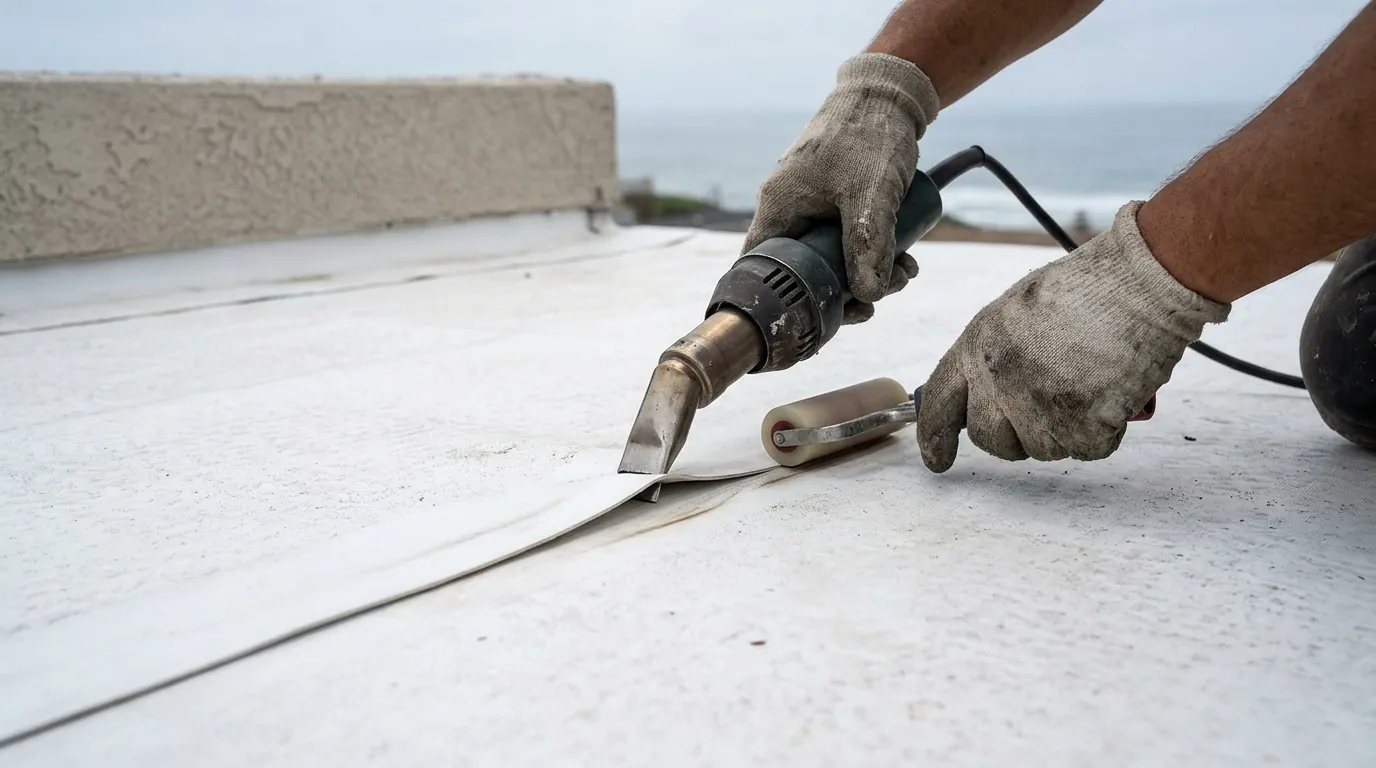
Weld quality: where TPO roofs succeed or fail
A TPO roof is only as good as its welds. The welder temperature and speed have to match the air temperature, sheet and wind. Too cold and the seam looks closed but peels apart. Too hot and the sheet scorches and weakens. Our roofers run test welds at the start of each day and pull them apart by hand to confirm the setting.
After welding, every seam is probed with a blunt hook tool to find gaps. Corners, pipe boots and curb wraps get pre-formed accessories or careful field-fabricated patches, because those small pieces are where most TPO leaks begin.
When to call about tpo roofing
Hot rooms under roof
Bedrooms or offices under a dark flat roof that stay hot into the evening are a strong case for a white reflective sheet.
Old cap sheet crumbling
Granules washing into the gutters and bare black patches mean the old surface is near its end.
Title 24 re-roof
Some low-slope re-roofs must meet cool roof requirements, and TPO is one of the common ways to meet them.
Garage or addition roof
Small flat sections tied into a pitched roof are a good fit for TPO with welded flashing at the wall.
Seams opening on TPO
An existing TPO roof with peeling laps may need re-welding or a new sheet if the material has aged.
Adding solar panels
A fresh TPO roof under new panels avoids removing the array later to replace the roof.
Typical cost in Long Beach
What tpo roofing usually costs
$7.10 to $12.40 per sq ft
- Sheet thickness: 45, 60 or 80 mil
- Adhered versus mechanically fastened attachment
- Insulation or cover board added under the sheet
- Tear-off of old layers and deck repair
- Number of pipes, curbs and parapet walls to flash
These are typical Long Beach ranges, and the real number comes after we look at your roof. See every price range.
Why TPO works on so many Long Beach low-slope roofs
Long Beach summers are long, dry and bright. A white TPO surface reflects much of that sun instead of soaking it into the deck, which helps the Cliff May homes of Rancho Estates, the flat-roofed additions in Los Altos and the Plaza, and the top-floor units of apartment buildings downtown. California's Title 24 energy code can require cool-rated roofing on some low-slope re-roofs, so we check what applies to your roof before ordering material.
Near the water in Belmont Shore, Naples and along Ocean Blvd, the marine layer leaves a film of salt and grime on white roofs, so we suggest an occasional rinse to keep it reflective. Edge metal near the coast gets a corrosion-resistant finish. The City of Long Beach requires a building permit for re-roofing, which we pull before work starts.
How the job runs
How our crew handles tpo roofing
- 1
Inspect and measure
We check the deck, drains and existing layers, then confirm whether TPO is the right system for your roof.
- 2
Strip and prepare
Old roofing comes off, damaged decking is replaced and a cover board or insulation is installed.
- 3
Lay and attach sheet
Rolls are positioned to shed water toward drains, then adhered or fastened per the chosen system.
- 4
Weld and detail
Seams are hot-air welded, and corners, pipes, curbs and edges get matching TPO flashing pieces.
- 5
Probe and walk through
Every seam is probed, drains are water-tested, and we walk the finished roof with you.
FAQ
TPO Roofing questions
How long does a TPO roof last in Long Beach sun?
A well-installed TPO roof commonly gives many years of service, with life depending on thickness, drainage and how much traffic it sees. Strong UV slowly thins the top layer, which is why we favor 60 or 80 mil sheets here. Keeping drains clear and the surface rinsed helps it last.
Is TPO roofing loud when it rains or in wind?
Fully adhered TPO is quiet because the sheet is glued to the board below and cannot flutter. Mechanically fastened sheets can lift and drum slightly in strong gusts. On homes we usually adhere the sheet for that reason.
Can TPO roofing be walked on for maintenance?
Yes, TPO handles normal service traffic, especially at 60 or 80 mil over a cover board. For roofs where technicians visit equipment often, we add walkway pads along the routes they use.
Does a TPO roof qualify as a cool roof?
White TPO is a common choice where a cool-rated roof is required, but whether it qualifies depends on the specific product. We confirm what your re-roof needs under Title 24 and order a sheet that meets it.
Can you repair a small tear in my TPO roof?
Usually, yes. We clean the area, then heat-weld a TPO patch over the damage. If the old sheet is too aged to weld well, we explain whether a larger section or a full replacement makes more sense.
Where we do this work
TPO Roofing around Long Beach
Our crews do this work across Long Beach and the cities around it. A few of the places we cover:
A leak, a quote, or a question about your roof?
Call Denco at (562) 414-1770. Someone answers 24 hours a day, and our crews work out of Long Beach and La Mirada.