Mid-century roofs
Flat and low-slope roof options for mid-century homes
Cliff May ranchos and other mid-century homes need flat and low-slope roofs that drain well and keep the clean roofline. Here is how the main options compare.
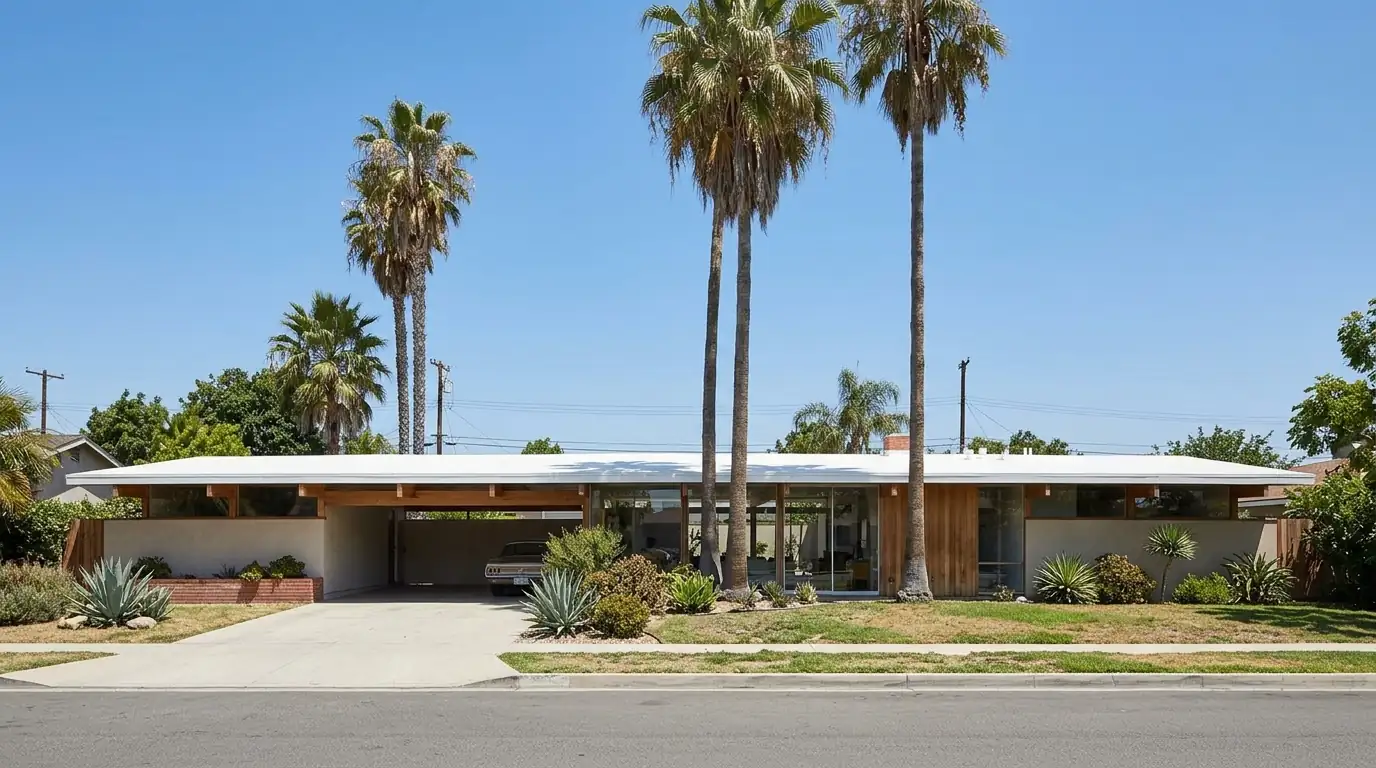
Long Beach has some of the best-known mid-century housing in Southern California. The Cliff May ranchos in Rancho Estates, built in the 1950s, are famous for their low-slope and flat roofs, wide eaves and open, glass-filled walls. Many other post-war homes, additions, garages and covered patios across East Long Beach share the same low roof lines. These roofs are a big part of what makes the houses look the way they do.
They are also the roofs that give owners the most trouble. Water drains slowly from a nearly flat surface, the sun hits it all day, and the original materials are long past their prime on most homes. This guide compares the main flat and low-slope roof systems, explains what suits these houses and covers the details that matter more than the brand of membrane.
Why these roofs need special care
A low-slope roof does not shed water as fast as a pitched roof. Any low spot, clogged drain or open seam lets water sit, and standing water finds weak points over time. Mid-century roofs often have very shallow pitch, interior drains, scuppers through parapets and long runs that can sag a little over decades.
The design makes it more delicate. Wide eaves, exposed beams and thin fascia lines mean there is little room to build up a thick roof without changing the look. Many of these homes also have clerestory windows, skylights and post-and-beam framing where the roof ties into glass, which calls for careful flashing.
And then there is the sun. A dark flat roof in a Long Beach summer gets very hot, which dries out asphalt-based materials and heats the open rooms below.
The main options, compared
Each system has a place, and the best choice depends on the roof's slope, drainage, what is there now and how much rooftop traffic it will see. Here is a plain comparison with typical Long Beach ranges. The real price for your roof comes after we look at it.
No single system wins on every roof. A garage with a simple slope might be best with torch-down, while the main house with skylights and interior drains might be better with a single-ply membrane.
- Hot mop (built-up roofing): layered asphalt and felt, the classic original system, $5.90 to $9.60 per sq ft
- Torch-down (modified bitumen): rolls heat-welded in place, tough and common on homes, $6.40 to $10.80 per sq ft
- TPO: a white single-ply membrane with heat-welded seams, light and reflective, $7.10 to $12.40 per sq ft
- PVC: a single-ply membrane with welded seams that handles ponding and chemicals well, $8.30 to $13.90 per sq ft
- Spray foam: sprayed in place, adds insulation and builds slope, then coated, $5.80 to $9.90 per sq ft
- Roof coating: applied over a sound existing roof to extend its life, $3.20 to $6.10 per sq ft
Matching the system to the house
On many Cliff May ranchos and similar homes, the goal is a roof that reads the same from the street: low, clean and thin at the edge. Single-ply membranes such as TPO and PVC are thin, light and come in white or light gray, so they keep the fascia line slim. Their welded seams also handle the low spots that these roofs tend to have.
Torch-down and hot mop systems are proven and often a good fit for simpler roofs, garages and additions. They build up a little thicker, and the cap sheet can be finished with reflective granules. Spray foam has a strong case on roofs that need better insulation or where we want to build in a bit more slope, but it adds thickness at the edge, so we look closely at how it would change the eave before recommending it.
Coatings are not a new roof. They work when the existing membrane is sound, the deck is dry and the main goal is to add years and reflectivity. Over a wet or failing roof, a coating just hides the problem.
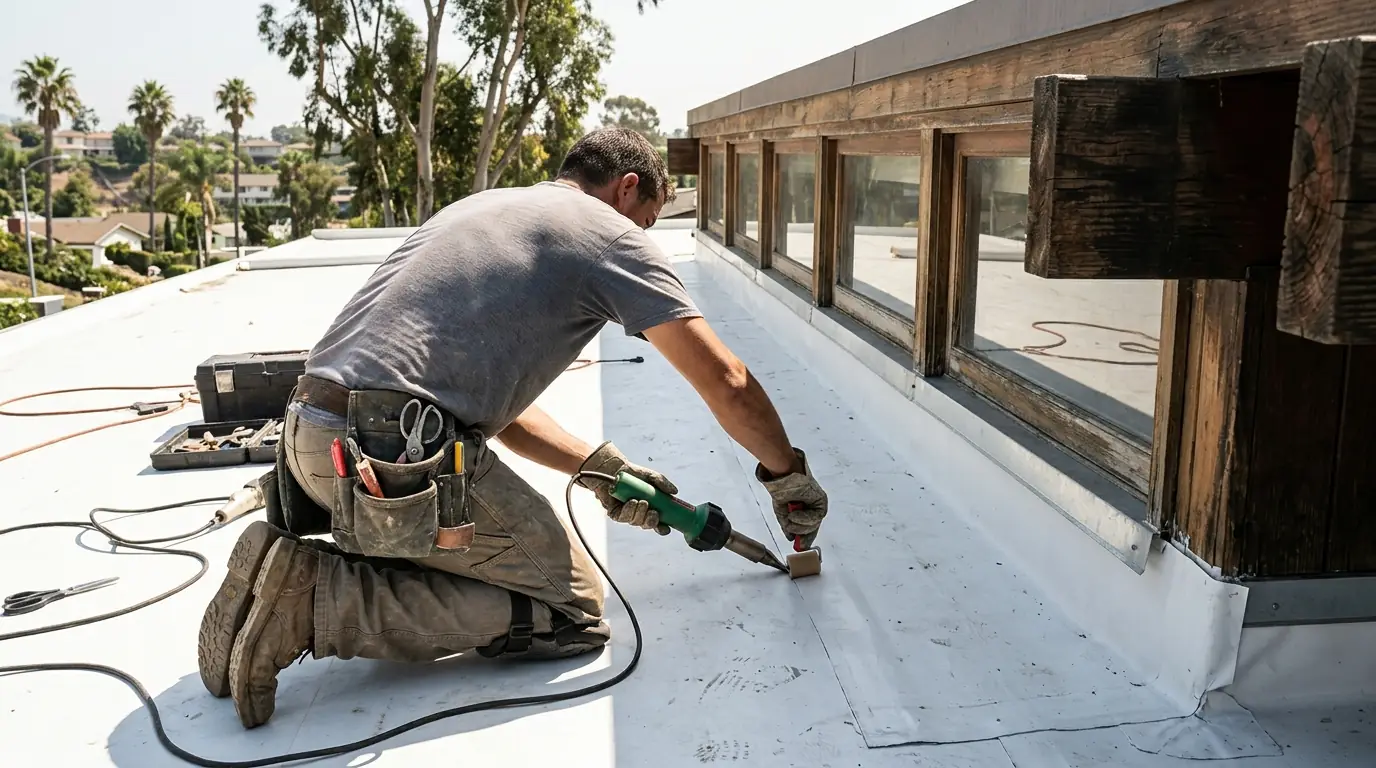
Drainage and details matter more than the membrane
The most common cause of flat roof failure we see is not the membrane brand. It is water that cannot get off the roof. Before choosing a system, we map where water sits after rain, check the drains and scuppers and look for sagging. Fixing drainage can mean adding tapered insulation, crickets to steer water toward drains or larger scuppers.
The edges and penetrations come next. Skylights, clerestory windows, pipe vents, HVAC stands and the joint where a flat roof meets a wall all need flashing that suits the chosen system. On mid-century homes with exposed beam ends that run through the roof line, each beam is a potential leak point and needs careful detailing.
- Map ponding areas and fix slope where needed
- Clear and size drains, scuppers and overflows
- Flash skylights, clerestories and beam ends to suit the system
- Keep the fascia line thin to protect the look of the house
- Check the deck for rot before any new roof goes on
Cool roofs and energy rules
Low-slope roofs are the ones most often affected by California's Title 24 energy code, which can require cool-rated roofing on some re-roofs depending on slope and climate zone. We check what applies to your roof before ordering material.
On most mid-century homes, a light-colored roof is barely visible from the street because of the low pitch, so meeting the rule rarely changes the look. It does change how the house feels inside. Those open, glass-filled rooms under a flat roof heat up fast, and a reflective roof surface helps keep them comfortable through a long summer.
Signs your flat roof is near the end
Flat roofs give warnings before they fail completely. If you see several of these, it is time to look at repair versus replacement. Flat roof repair typically runs $395 to $1,620 for a typical repair in Long Beach, and full flat roof replacement typically runs $6.40 to $13.90 per sq ft. The real price comes after we look at the roof.
- Water that stays on the roof a day or more after rain
- Blisters, cracks or wrinkles across the membrane
- Seams that are lifting or splitting
- Soft spots when walked on, or stains on ceilings below
- Exposed felt or bare spots where the surface has worn away
Planning the work on a mid-century home
Flat roof replacements usually go quickly once started, since there is no tile to remove or reinstall. We tear off by sections and keep the house dried in at the end of each day. The City of Long Beach requires a building permit for re-roofing, and we handle it as part of the job.
Plan for late summer or fall if you can, before the atmospheric-river storms arrive in winter. A new flat roof needs dry weather to go on well, and you want it in place before the first heavy rain, not halfway through the season.
Key takeaways
- Mid-century roofs fail most often from poor drainage
- Single-ply membranes keep the roof edge thin and clean
- Coatings extend a sound roof, they do not fix a failing one
- Low-slope re-roofs often need cool-rated material
About the author
Hubert Tisdale edits Roof Advice for Denco Roofing Company. The articles draw on what our roofers see on Long Beach roofs every week.
FAQ
Reader questions
Will a new flat roof change how my Cliff May rancho looks from the street?
It should not, if it is planned well. Thin single-ply membranes keep the fascia line slim, and the low pitch means the roof surface is barely visible from the street. We check the eave and edge details before choosing a system so the roofline stays as designed.
Can spray foam fix the ponding on my mid-century flat roof?
Spray foam can be built up thicker in low areas to add slope and move water toward drains. It also adds insulation. It does thicken the roof edge, so on homes with a very thin fascia we compare it with tapered insulation under a single-ply membrane.
How should beam ends that run through a mid-century roof be sealed?
Exposed beam ends need flashing that wraps the beam and ties into the roof membrane, with sealant rated for sun exposure. Older beams often have dry rot at the ends, which we check when the roof is open. A well-flashed beam end keeps water out of both the roof and the wall below.
A leak, a quote, or a question about your roof?
Call Denco at (562) 414-1770. Someone answers 24 hours a day, and our crews work out of Long Beach and La Mirada.